Imagine a busy restaurant kitchen. When a waiter takes an order, they don't stand at the chef's elbow waiting for each dish to be cooked before going back to the dining room. They call out the order, pin it to the ticket rail, and move on. The chef picks it up when ready. The dishwasher knows to expect dirty plates. The expediter watches for completed dishes. Everyone reacts to what happened — the order was placed — without anyone needing to call each other directly.
That's the intuition behind event-driven architecture. It's a way of designing software systems where components communicate by announcing what just happened, rather than by directly calling one another and waiting for a reply. Understanding this pattern reveals why it has become one of the dominant approaches for building large-scale, resilient applications.
The Problem with the Traditional Approach
Most beginners first encounter the request-response model, sometimes called REST (short for Representational State Transfer). In this model, one piece of software — the client — sends a request directly to another piece — the server — and waits for an answer. Think of it like a phone call: you dial, you wait, you get a response.
This works beautifully for simple, small systems. But as applications grow, it creates friction. If Service A needs to talk to Services B, C, and D, it has to know where each of them lives, how to talk to each one, and what to do if any of them is slow or offline. Every new consumer of that information means a new direct connection that A has to manage. The system becomes tightly coupled — change one piece and you risk breaking everything connected to it.
Event-driven architecture solves this by flipping the model.
How Event-Driven Architecture Actually Works
Events, Producers, and Consumers
An event is simply a record that something happened. "Order placed." "Payment processed." "User signed up." It's a fact about the world, captured at a moment in time.
A producer (sometimes called a publisher) creates and broadcasts that event. A consumer (or subscriber) listens for events it cares about and reacts accordingly. Crucially, the producer doesn't know — and doesn't need to know — who's listening. It just announces what happened and moves on.
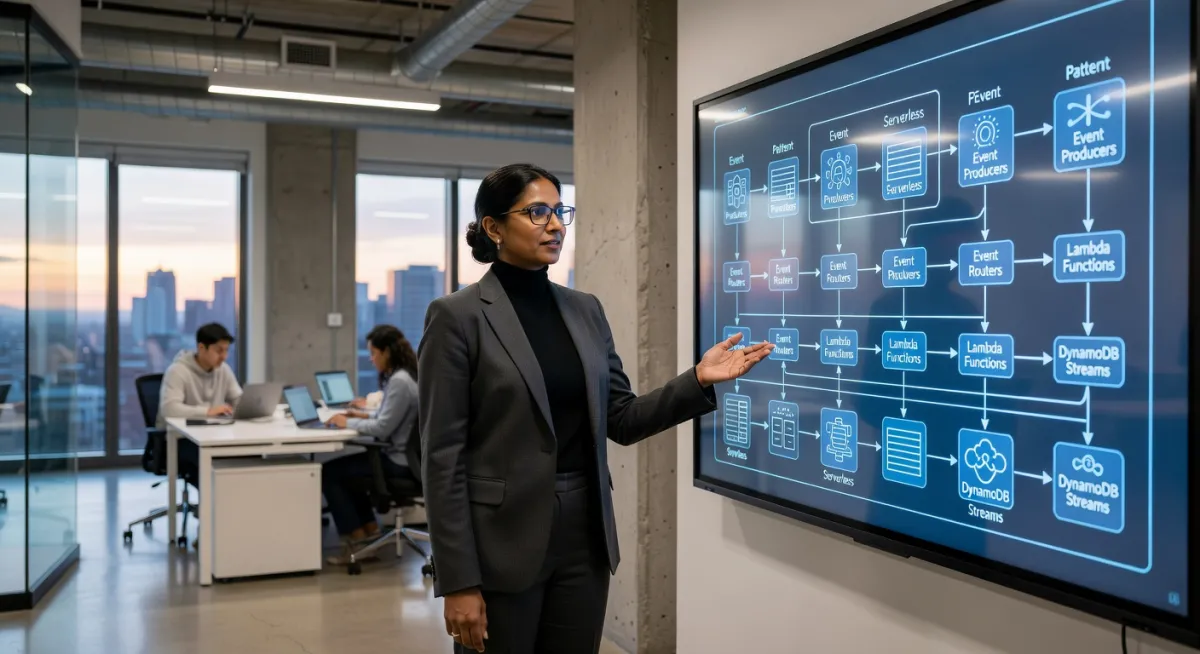
Event-driven architecture is distinct from request-response (REST) architecture in that producers of events have no knowledge of which consumers will process them, enabling loose coupling. That phrase — loose coupling — is the key idea. Services are decoupled from each other: you can add a new consumer without touching the producer, and you can take a consumer offline without breaking anything else.
The Event Bus or Broker
Between producers and consumers sits an event broker — a piece of infrastructure that receives events and delivers them to whoever has subscribed. Think of it like a postal sorting office. Senders drop off letters; the office routes them to the right recipients. The sender doesn't need to know the recipient's exact address or whether they're home right now.
The broker holds events durably, meaning consumers can process them at their own pace. If a service goes down temporarily, events queue up and get processed when it comes back. This is a fundamental source of resilience.
A Real-World Example: Apache Kafka
No discussion of event-driven architecture is complete without mentioning Apache Kafka, the platform that helped bring this pattern into mainstream engineering. Apache Kafka, one of the most widely adopted event streaming platforms, was originally developed at LinkedIn and open-sourced in 2011.
Kafka works by organizing events into named topics — categories like "user-signups" or "payment-events." Producers write events to a topic. Consumers subscribe to topics and read events from them, independently of one another. Kafka stores events durably and in order, so multiple consumers can read the same stream at their own pace, and events can be replayed if needed.
The scale Kafka operates at is hard to comprehend. Kafka processes more than one trillion events per day across companies like LinkedIn, according to LinkedIn engineering blog posts. A trillion events per day. That's a testament to how well the event-driven model handles enormous, continuous workloads that would buckle a traditional request-response system.
Managed Event Infrastructure: Not Just Open-Source
Running your own Kafka cluster is powerful but complex. Cloud providers have responded by offering managed event routing services. Amazon's EventBridge is one prominent example. Amazon EventBridge, AWS's managed event bus service, supports routing events from over 200 AWS services to downstream targets without custom integration code. This means a developer can wire up, say, a file upload in S3 to trigger processing by a Lambda function, a database update, and a notification — all through event routing, with no custom glue code.
The pattern is the same whether you're running Kafka yourself or using a managed cloud service: announce what happened, and let interested parties react.
Making Events Speak the Same Language: CloudEvents
One practical headache in event-driven systems is that different platforms format their events differently. An event from one service might look nothing like an event from another, making it hard to write generic consumers that can handle both.
The industry has moved toward standardization. The CNCF (Cloud Native Computing Foundation) CloudEvents specification reached v1.0 in October 2019, standardizing event metadata format across platforms to improve interoperability. CloudEvents defines a common envelope for events — fields like the event source, the event type, the time it occurred — so that tooling and consumers can handle events from many different producers in a consistent way. It's the equivalent of standardizing envelope sizes in the postal system.
Managing Complexity: Choreography and Sagas
Once you have many services communicating through events, a new challenge emerges: how do you manage a multi-step business process — like placing an order, charging a card, and shipping a product — when each step is handled by a separate service?
This is the problem of distributed transactions, and one elegant event-driven solution is the saga pattern. Instead of one central coordinator bossing everyone around (which creates a single point of failure), each service listens for the event it cares about, does its work, and emits a new event for the next service to pick up.
Choreography-based sagas, a pattern for managing distributed transactions in event-driven microservices, avoid the single-point-of-failure risk of centralized orchestrators by having each service react to events and emit new ones. Think of it like a relay race: each runner hands off the baton to the next without a referee having to physically move it. The choreography emerges from the sequence of events, not from a central director.
Event Sourcing: The Event Log as Truth
There's a deeper way to use events beyond just communication: you can make events themselves the authoritative record of your system's state. This is called Event Sourcing.
In a conventional database, you store the current state of things — the balance in an account today. In an event-sourced system, you store the full sequence of events that produced that state — every deposit, every withdrawal, in order. The current balance is derived by replaying those events. You can reconstruct the state at any point in history, which is invaluable for auditing, debugging, and understanding exactly what happened.
The concept of the event log as a source of truth — sometimes called Event Sourcing — was formalized in enterprise architecture literature by Greg Young around 2010 and is now widely implemented in systems requiring full audit trails. Financial systems, healthcare records, and legal platforms have embraced this approach because the immutable history of what happened is often more valuable than a snapshot of current state.
Why This Makes Systems More Resilient and Scalable
Let's pull the thread together. Event-driven architecture delivers two big structural advantages:
Resilience
Because services don't call each other directly, a slow or failing service doesn't cascade failures to everything else. Events queue up in the broker and get processed when the service recovers. The system degrades gracefully instead of collapsing.
Scalability
Because consumers are independent, you can add more instances of a busy consumer to handle load — without changing producers or other consumers. When a particular type of event causes a processing backlog, you scale that one consumer. Everything else stays untouched. This fine-grained scalability is one reason event-driven systems handle internet-scale workloads so well.
Tradeoffs Worth Knowing
Event-driven architecture isn't a silver bullet. The loose coupling that makes it powerful also makes it harder to trace the flow of a request through the system — events scatter across services, and debugging requires good logging and tracing tools. Eventual consistency (where different parts of the system may be momentarily out of sync) is a fact of life, and designing for it requires care. And the infrastructure — brokers, topics, schemas — adds operational complexity that a simple REST API doesn't.
For small, simple systems, direct request-response is often cleaner. But once a system grows beyond a handful of services or needs to handle millions of events reliably, the event-driven model's advantages tend to outweigh its costs.
The Core Idea, Restated
Event-driven architecture is ultimately a shift in how software components relate to each other. Instead of "call this service and wait," it's "announce what happened and move on." That shift — from direct commands to shared facts — is what enables the loose coupling, resilience, and scale that modern applications demand.
The restaurant kitchen keeps running even when one chef takes a break. That's the goal: a system where each part can do its job independently, connected not by rigid wires but by a shared stream of what's happening in the world.
Sources
Every factual claim in this article was independently verified against the following sources:
- Apache Kafka - Wikipedia — en.wikipedia.org
- How We’re Improving and Advancing Kafka at LinkedIn | LinkedIn Engineering — engineering.linkedin.com
- What is event-driven architecture? — redhat.com
- Getting Started with AWS EventBridge: Optimize Your Serverless Workflows — cloudchipr.com
- Serverless specification CloudEvents reaches Version 1.0 | CNCF — cncf.io
- Saga Pattern: Orchestration vs Choreography in Microservices | Distributed Transactions — scalewithchintan.com
- BACHELOR THESIS Hani Alshikh Evaluation and Use of Event-Sourcing for Audit — reposit.haw-hamburg.de